India’s Vikram-1 rocket lifts off
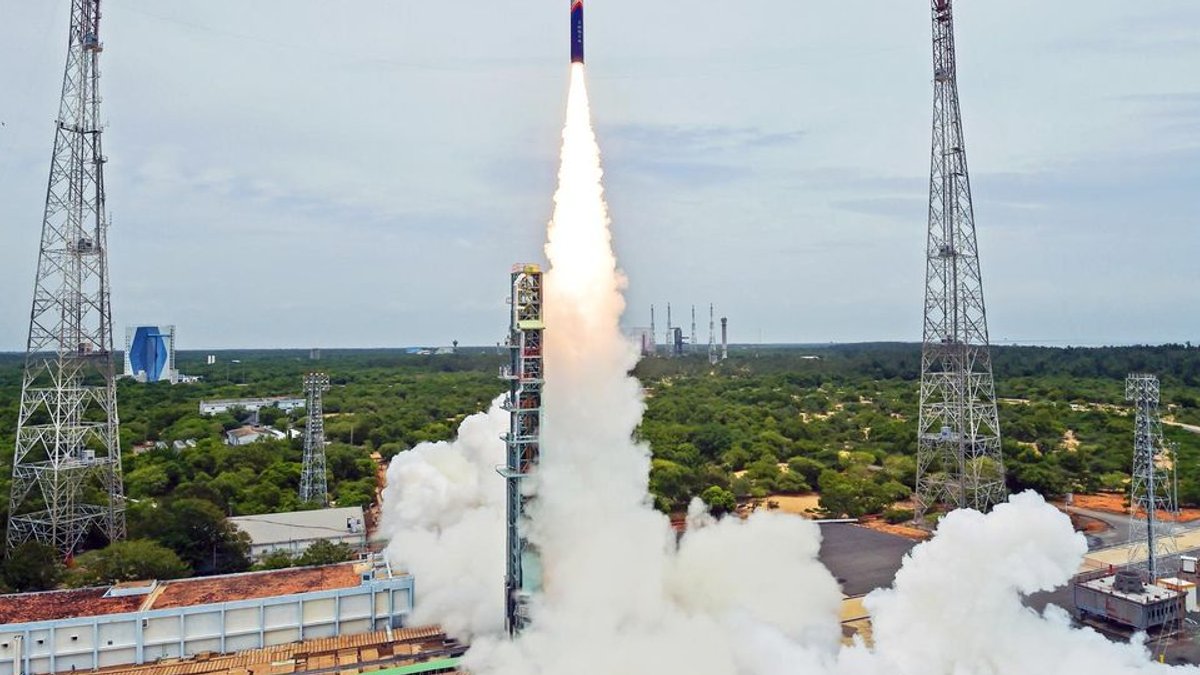
India’s private space sector reached a milestone last week when Skyroot Aerospace successfully launched its Vikram-1 rocket from the Satish Dhawan Space Centre in Sriharikota. The four-stage vehicle, powered by solid-fuel engines, delivered three small satellites into low Earth orbit—marking the first time an Indian startup has achieved a fully commercial orbital launch without government payloads onboard.
Solid fuel and modular design cut costs
The Vikram-1 stands 20 meters tall and weighs 545 kilograms at liftoff. Its first three stages use carbon-composite motor casings filled with a proprietary solid propellant, while the fourth stage switches to a liquid-fueled engine for precise orbital insertion. Skyroot states the design reduces manufacturing costs by 40% compared to traditional metal casings, making small-satellite launches more affordable. No independent analysis has confirmed these cost savings.
Skyroot has raised $95 million, including a $51 million Series C round last year.
Regulatory hurdles remain despite policy reforms
India opened its space sector to private companies in 2020, ending a six-decade monopoly by the state-run Indian Space Research Organisation (ISRO). The government established IN-SPACe, a regulatory body to license commercial launches, share ISRO infrastructure, and set safety standards. Skyroot’s launch was the first approved under the new framework.
Related: IEEE Program Inspires Indian Girls Toward STEM Careers
Industry observers note that approvals still take time. Startups must work with several agencies, including the Department of Space, the Directorate General of Civil Aviation, and the Department of Telecommunications, each with distinct requirements.
Despite delays, investment continues. Over 150 space startups have registered in India since 2020, according to the Indian Space Association. Most focus on satellite manufacturing and ground services.
The Vikram-1 success may change that. If Skyroot proves reliable, it could attract customers who currently depend on SpaceX or Arianespace for rideshare missions. However, with a payload capacity of just 300 kilograms to low Earth orbit, the rocket suits only small satellites, leaving larger payloads to ISRO’s heavier vehicles.
India’s space startups are gaining ground but still face challenges. The infrastructure, funding, and regulatory support needed to compete globally will take time. For now, Skyroot’s achievement shows that India can build rockets without government funding.
Related: AI coding succeeds creating new CIO challenges
Next test: scaling up and turning a profit
Skyroot’s next launch, planned for early 2025, will carry a 150-kilogram satellite for a European customer. The company has also signed an agreement with ISRO to use its launchpad at Thumba Equatorial Rocket Launching Station in Kerala for future missions.
The bigger challenge is financial. Small launch vehicles have struggled globally. Rocket Lab, the sector leader, posted its first annual profit only last year after a decade of losses. Skyroot’s executives say they can break even with 12 launches annually, but analysts doubt the market for sub-500-kilogram payloads can support multiple competitors.
For India, the stakes extend beyond business. The country’s space program has long prioritized national development—communications, weather forecasting, and remote sensing—over commercial ventures. Private launches could allow ISRO to focus on deep-space missions, such as the Chandrayaan-3 lunar landing and the upcoming human spaceflight program. If startups fail, the government might revert to its old approach, limiting innovation.
The Vikram-1 launch lasted 12 minutes. The satellites it carried—a climate-monitoring unit from Space Kidz India, a student-built cubesat from NIT Nagpur, and a commercial imaging satellite from Armenia’s BazumQ Space Research Lab—are now operational. Ground stations in Bengaluru and Yerevan have confirmed stable telemetry.

IEEE Program Inspires Indian Girls Toward STEM Careers


